Transformational Leadership and a Culture of Relationships
Creating value in complex and intercultural contexts
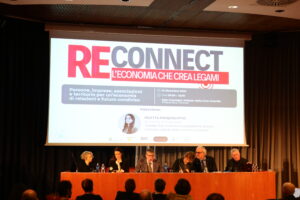
In recent years, talking about economics, organizations, and work without including the relational dimension has become increasingly limiting. Events such as RE.CONNECT – The Economy That Creates Connections, held at the Gran Guardia in Verona, stem from this very awareness: the future of the economy cannot be separated from people, relationships, and the cultural contexts in which they operate.
It is from this perspective that my work in cultural consultancy takes shape, supporting companies, institutions, and organizations operating in complex, international, and highly diverse environments.
Through tailored programs in transformational leadership and managerial development, I work alongside leaders, HR professionals, and teams to address a question that is becoming increasingly central:
How can organizations create sustainable value, performance, and well-being in multicultural and constantly evolving environments?
Beyond numbers: the invisible role of relationships
Workplaces are not only spaces where skills, objectives, and processes circulate. They are also places where personal histories, values, cultural expectations, and often invisible vulnerabilities are present. These elements profoundly influence how people communicate, make decisions, manage conflict, and collaborate.
Ignoring this complexity may seem efficient in the short term, but in the medium to long run it leads to misunderstandings, misalignment, and a loss of trust. By contrast, acknowledging the human and cultural dimensions of work enables organizations to turn complexity into a strategic resource.
“Wounds” as a cultural lens
At the root of many organizational dynamics—especially in intercultural contexts—lie unprocessed experiences: lived realities, tensions, episodes of exclusion or misunderstanding. In a broad sense, these can be described as wounds.
These wounds are not obstacles to be removed, but valuable information. When left unacknowledged, they rigidify behaviors and fuel polarization. When recognized and managed, they can become bridges—opportunities for learning, dialogue, and trust-building.
This is where culture—understood both as a subjective dimension (values, identity, emotions) and an objective one (rules, structures, systems)—plays a central role. Each individual embodies a unique synthesis of these dimensions, expressed daily in the workplace.
Transformational leadership: stewarding relationships
Within this landscape, transformational leadership emerges as one of the most effective approaches to leading complex organizations.
Transformational leadership goes beyond performance management. It is a form of leadership that:
- stewards relationships
- recognizes people’s potential alongside their vulnerabilities
- accompanies change rather than imposing it
- creates meaning, not just results
This leadership style, strongly supported by decades of management research, is grounded in collaboration, trust, and a shared sense of purpose. It does not reduce complexity; it inhabits it, avoiding the oversimplification of human behavior.
In intercultural teams in particular, transformational leadership becomes a strategic competence: it enables leaders to decode cultural differences, prevent latent conflict, and foster psychological safety.
From macro to micro: where real change happens
We live in a global market that tends to treat people as homogeneous consumers. Yet organizations are made up of deeply diverse individuals.
Real change does not happen only through grand strategies or abstract models, but in the micro:
- in everyday decisions
- in the language leaders use
- in listening practices
- in how mistakes and conflicts are managed
It is within these micro-actions that a relationship-based organizational culture is built—or weakened.
Towards a relational economy
Building an economy that values cultures, protects dignified work, and leaves no one behind requires a shift in perspective. It calls for leaders and organizations capable of seeing complexity as an integral part of value creation.
Transformational leadership, combined with strong cultural competence, is today one of the most powerful levers for generating positive, sustainable, and human-centered impact.
These principles underpin my consulting and training programs, which focus on:
- leadership and managerial skills development
- managing intercultural and international teams
- supporting HR and People Managers in building inclusive organizational cultures
- accompanying organizational change processes
A relational economy is built this way: through awareness, listening, and the daily—intentional—choice to create connections.
👉 If your organization operates in complex and international contexts and seeks to develop a leadership approach capable of turning diversity into value, get in touch to explore a tailored path together.