Gender bias in leadership: what we learned in a seminar with HR experts
Why we need to talk about bias in leadership
When you picture a good leader, which qualities come to mind? Confidence, decisiveness, ambition? The catch is that these qualities are not perceived in the same way when they are shown by a man or by a woman. Gender bias in leadership is made of mental shortcuts, often unconscious, that shape who we consider “fit to lead” and who we don’t.
To make this mechanism visible, I ran a small experiment during a seminar for HR and diversity & inclusion professionals: people with solid experience on the topic, who know stereotypes and prejudice well.
The experiment: choosing the next CEO
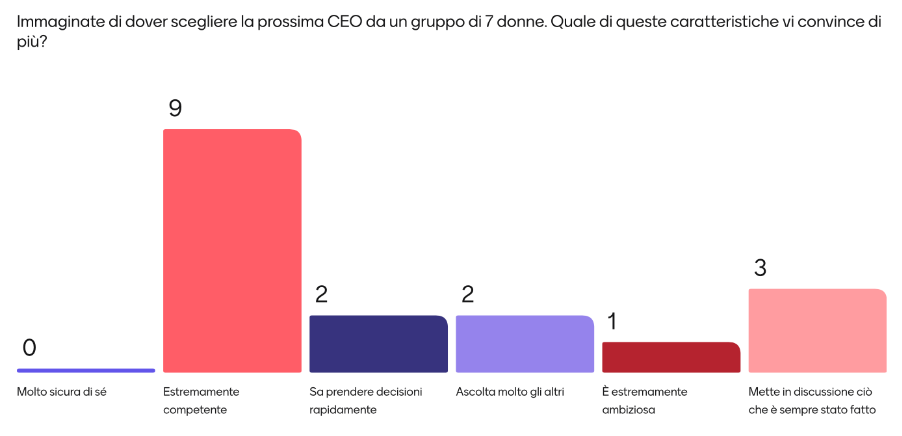
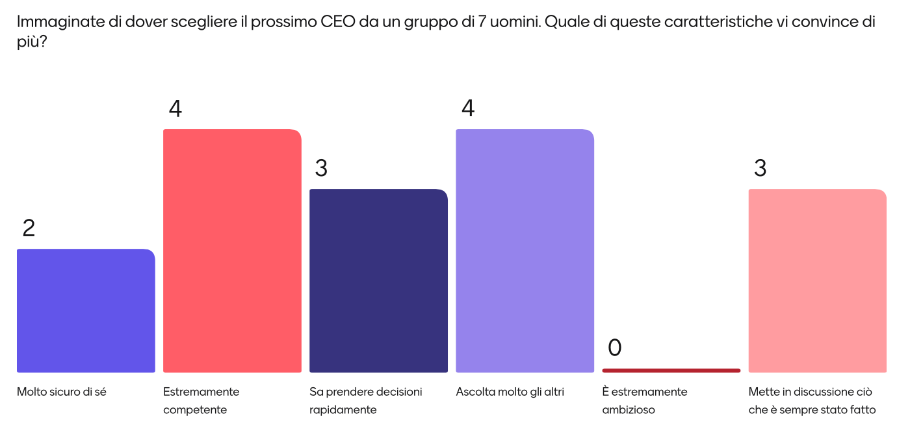
I asked participants the same question in two versions. In the first, they had to imagine choosing the next CEO from a group of seven women; in the second, from a group of seven men. In both cases they picked the one quality that convinced them most, out of six options: strong self-confidence, extreme competence, quick decision-making, listening skills, ambition, and a tendency to challenge the status quo.
What the results show
The clearest difference concerns competence. For the female CEO it was the deciding quality for 9 voters out of 17, more than half. For the male CEO it was chosen by 1 voter in 4 (4 out of 16), tied with listening skills.
| Quality | Group of women | Group of men |
|---|---|---|
| Extremely competent | 9 | 4 |
| Listens carefully to others | 2 | 4 |
| Makes decisions quickly | 2 | 3 |
| Challenges the way things have always been done | 3 | 3 |
| Very self-confident | 0 | 2 |
| Extremely ambitious | 1 | 0 |
When looking at a group of women, we mostly look for proof of competence. When looking at a group of men, competence seems easier to take for granted, and we weigh other traits, such as self-confidence.
The other data points the same way: self-confidence received no votes for women and two for men, while ambition received one vote for women and none for men. The numbers are small, but they are consistent with what research on the topic has described for some time: women are often asked to prove more in order to be seen as leaders.
Same behavior, different judgment
The real problem is not the difference itself, but what happens when behavior is identical. A frequent example is communication style: the same direct language, focused on facts and on the decisions to be made, is read differently depending on who is speaking.
When identical behavior is rewarded in one case and penalized in the other, we are looking at a real distortion in evaluation, with concrete effects on careers, promotions and access to senior roles.
Not (entirely) a bad thing, but it must be made visible
Men and women can have different leadership styles, and acknowledging this is not a problem in itself. The point is to notice when a difference does not come from actual behavior but from the expectations we project onto people. Bringing these differences in perception to light is the first step to reducing them. These mechanisms concern all of us, including those who work on the topic every day, which is exactly why they are worth observing without judgment.
How to reduce bias in leadership evaluation
- Define objective criteria in advance. Decide before the evaluation which behaviors and results matter, and measure them the same way for everyone.
- Use the gender-swap test. Ask yourself: “Would I judge this behavior the same way if a person of a different gender did it?”
- Rely on evidence. Prefer documented facts and results to vague impressions such as “she has grit” or “he’s too tough.”
- Involve multiple evaluators. Diverse panels reduce the weight of individual prejudice.
- Train regularly. The seminar confirmed it: knowing about bias is not enough to eliminate it; you have to practice recognizing it.
Conclusion
If even those who work on diversity and inclusion every day recognize in themselves different perceptions of male and female leaders, it means these mechanisms are part of all of us, and there is nothing to be ashamed of. The good news is that biases, once made visible, can be discussed and reduced. The first step is to look at how we evaluate leadership with curiosity.
Methodological note. The data come from an informal poll run during a seminar, with a very small sample (17 and 16 responses). The results are illustrative and do not represent a statistical survey.
Want to bring this topic to your organization?
I run seminars and programs on bias, leadership and inclusion for companies, public administrations and non-profits. Get in touch to talk about it.
